









Why records matter more than ever.
Earlier this month, while I was presenting at ZorkFest, several attendees asked me about the One Big Beautiful Bill Act (H.R. 1, 119th Congress) and how it might change gambling taxes. My answer at the time was honest. I was cautiously optimistic that a legislative fix would undo the new 90 percent rule, and I was not going to stress over something that might never take effect.
Now the calendar has caught up with us. With the new year just days away, it is clear that this rule is likely to be in effect, at least for now. It is still possible that Congress could revisit or remove it later this year. Until then, the most practical response as smart gamblers is not panic or drastic changes in play. It is better tracking.
Before anything else, a clear disclaimer. I am not a tax professional. I am not giving tax advice. This is perspective, not instruction. You should talk with a qualified tax professional about your own situation.
So what does the OBBBA actually say, based on what we know today?
H.R. 1 appears to raise the federal W-2G reporting and withholding threshold for slots and video poker to $2,000. That change has been widely reported but is not yet fully clarified in officially published IRS guidance. It also came with a meaningful tradeoff. The bill introduced a 90 percent limitation related to deducting losses against wins. There is still uncertainty around how this applies in practice. It is not yet clear whether you are limited to deducting a maximum of 90 percent of total wins, or whether only 90 percent of total losses may be deducted. In edge cases, that distinction can materially change the outcome.
This uncertainty explains why gambling tax discussions have dominated online forums and group chats over the past few weeks. Many players are asking whether they need to change how they play in the new year. The short answer is that you should understand the risk, set a budget, and document everything.
Professor Bryan Camp explored how H.R. 1 interacts with existing gambling tax rules in a detailed Tax Notes article.
His analysis reinforces a long-standing reality. Outcomes often hinge on documentation. Wins, losses, and how you define a gambling session depend on what you can prove, not what you remember months later.
That same message came up in a recent episode of the Gambling with an Edge podcast released on 12/25/25 CPA Gary Kondler discussed two key tax court cases, Shollenberger v. Commissioner and Bonaparte v. Commissioner. Each case calculated gambling “sessions” differently, and those differences materially changed the tax outcome. The consistent lesson was simple. Clear, contemporaneous records matter.
Record keeping should start before you ever sit down to play. Setting a budget and understanding the tax implications of the games you choose is part of responsible gambling. This matters even at lower denominations. A $1 video poker machine may feel harmless, but a $4,000 royal flush can still create real tax consequences. Knowing that risk ahead of time helps you avoid surprises.
It is also critical to understand that all gambling income is taxable. Not just W-2Gs. Every win is technically reportable income. At the same time, losses can be tracked and potentially deducted, subject to limits. If you do not document losses as they occur, you cannot reliably reconstruct them later.
State rules add another layer. States tax gambling winnings differently. In some states, a win between $1,200 and $2,000 may still generate a state W-2G and trigger state withholding, even if no federal form is issued.
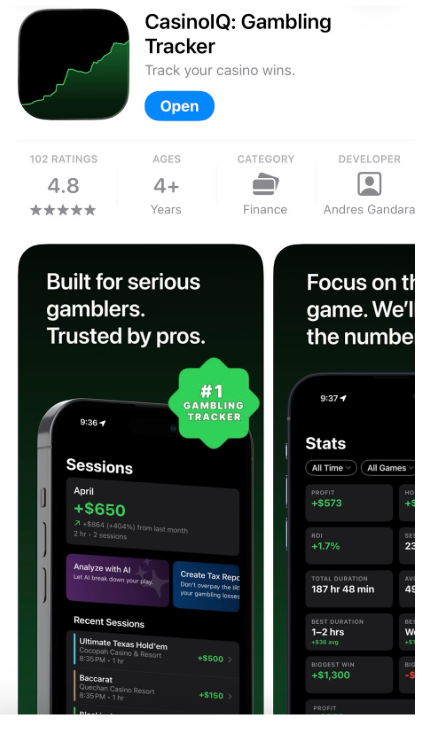
I started using the CasinoIQ app early this year after several years of inconsistent documentation. I tried notes apps, spreadsheets, and voice memos. None of them stuck. CasinoIQ finally gave me a single place to log sessions as they happened. It is a strong tool, with one limitation worth noting. It is only available for iOS users.
Some players, especially advantage players and professional poker players, file as professional gamblers. Specific rules determine who qualifies. Even if you do not file as a professional, this is an area where expert help matters. Firms such as Kondler & Associates and Clayton Tax have both been featured on Gambling with an Edge. Russell Fox of Clayton Tax is also the coauthor, with Jean Scott, of Tax Help for Gamblers. I am not endorsing any specific firm, but these practitioners clearly know the material. For some players, working with a specialist will be essential.
Beyond taxes, detailed tracking has another benefit. Recording coin-in, tier points earned, and free play redeemed helps you understand how your play drives casino offers. That insight feeds directly into smarter decisions about where and how you play, which I will explore in a future post.
Laws change. Court cases evolve. Good, detailed records remain your best defense and your best decision-making tool.
Join the TravelZork FB Group -> HERE
Visit: TravelZork Travel
Stay up to date with: ZorkFest
Also: Watch, Like, and Sub on YouTube
Check it out: The Yo-11 Minutes Playlist on YouTube
JonB is a longtime ZorkFest attendee, Vegas aficionado, and ZorkFest 2025 presenter. He found his way into casino loyalty after first exploring the points and miles world. While he doesn’t consider himself a points and miles expert, he knows how to find the right information and use it when it matters. That background helped him spot value in tier matches, casino promos, and comp systems, and he’s been chasing smart plays ever since.
You’ll often find him active in Vegas and gaming-focused social media groups, sharing a practical, no-nonsense approach to loyalty and recreational play. He considers himself a marginal advantage player who understands the math, looks for value, but still enjoys the entertainment side of the casino. Outside of the casino, he works in public safety and as a medical educator.